
Good Houseleaving
published in Fourth Genre, Fall 2025

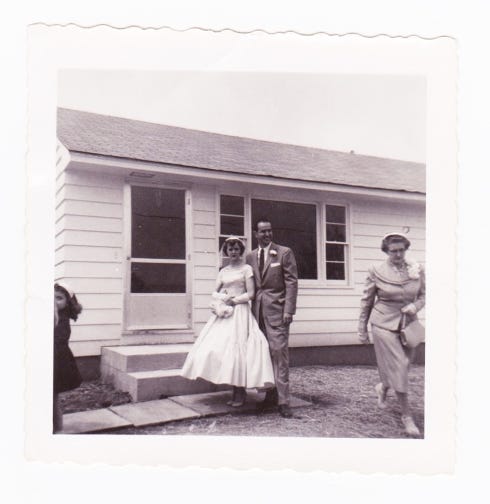
112 Bury Drive, Syracuse, NY 1956
1. April 2013: Enter the Realtor
“People like clean houses” one realtor tells my sister and me. “You should paint the walls a neutral beige; maybe take down the shower curtain and replace it with a sheer one. Definitely take the pictures off the mantel—you were planning on that, weren’t you? People like to be able to see themselves in the house.”
2. Undoing
Dave and Scott from Dustless Hardwoods come to the house to strip the carpet and refinish the floors. I am waiting for the Rescue Mission truck to come pick up the furniture we are donating and for Habitat for Humanity to come pick up my father’s table saw and jigsaw—hulking pieces of machinery that no one else knows how to use, or has space for. They have been sitting in the basement, waiting for someone to decide what to do with them, since my father died in 2009.
I watch Dave and Scott pull up the carpet; it takes only minutes. The oak floors, stained a light mahogany, are revealed. And there is another, darker, stain on top of the light mahogany from the rubber-backed carpet we had installed in 1972. By the picture window there is also the water stain from when the African Violet was overwatered.
When I come back from the local diner, where I’ve gone to get a cup of tea—there is nothing in the house-- Dave and Scott have started to sand the floor, and the dark stains of accidents and of intention have disappeared—the wood is a light, milky color. “That’s its natural color,” Scott says, “sort of a honey color. That’s what it will look like when we’ve refinished it.”
Are we leaving the house behind, or is it leaving us behind? I wonder about this as I drive east over Route 690, winding through Syracuse, to the New York State Thruway. Past farm fields and back to my own house in Clinton. It is only an hour drive, but it seems much farther. That night, I dream that my mother is sitting on my bed, here in my house in Clinton. I still have a pair of her pajamas, which still smell like her. They’re tucked under my pillow. I wonder if that’s what caused the dream.
3. What Thoreau said, and why he’s wrong
In Walden, Thoreau asks, “What is a house but a sedes, a seat?” He found many a site for a house, he said: “There I might live, I said; and there I did live, for an hour, a summer and a winter life” (chapter 2).
Only someone who has travelled lightly and lived with no particular attachment to physical objects could say this, I think. The house my sister and brother and I grew up in is only trivially a place to sit—a place to watch the world go by. Gaston Bachelard says that our childhood home leaves an imprint on us. It is not simply a geometrical object, but it is “our corner of the world”.
For us it was the site of arguments, and Saturday morning cartoon watching, and evenings watching the Carol Burnett Show, or Nightstalker, or the Partridge Family. It is where we decided when it was time to go to Sears for new clothes; where I signed student loan promissory notes against my father’s advice; where I sat and cried when I thought I couldn’t possibly meet the expectations set by my professors; where my mother, sister, and I decided that it was time to think about moving Dad into a nursing home. It was a place in which we decided things both trivial and important.
Its furnishings changed slowly: chairs and tables that moved in in the late 1970s were still around in 2012. The couch, a cast-off from my aunt and uncle, made of a faux velour with a flowered pattern, appeared sometime in the early 80s. Most of the things that entered the house never left. Except us, of course. And eventually everything else. Everything, that is, but the wooden floors, the walls, the appliances—the things that could easily be adapted to new occupancy.
Our house was a complicated place to sit and watch the world go by; it was the lodestar of our lives but it was too small to hold as many people and pets as it needed to hold. It was the place to which we returned at the end of the day; during college vacations; where we watched snow fall against the backdrop of the streetlight and wondered if there would be school the next day. Where we listened to the forced air heat turn on and off and the sound of snoring from our parents’ room as we lay in our little beds, thinking of the snow falling, frost collecting in the corners of the windows, creating intricate, yet thoroughly geometrical images, which we would discover in the morning. They were little surprises made out of what had been given by winter in this part of the country—snow and ice and cold, transformed into lacy designs on glass that was cold to the touch.
Thoreau’s form of house is something one can inhabit easily, and leave just as easily—it does not leave its marks, or give unexpected gifts. It is like a history that one can simply choose to let go of, a way of thinking of oneself as distinct from that history and those attachments. But human beings are not so easily pulled from places or from their history—though maybe Thoreau’s point is that they should be. Maybe this lack of attachment to things and places is virtuous; it seems very Zen to me. I guess I am decidedly un-Zen.
4. Being homesick
In her book about homesickness, Susan Matt traces the ways in which homesickness evolved in the 19th century in response to the changing demands of the workplace and ideals of individualism. Homesickness, she argues, came to be seen as a mark of immaturity, a shameful emotion. “Psychological advice and American folklore both enshrine and reinforce the ideology of individualism, promoting separation and ceaseless mobility as normal. Ordinary Americans have learned to follow the emotional pattern for rugged individualists: to separate, move on, and find consolation in sweet, nostalgic memories”.[i] Thoreau, for all his countercultural tendencies, seems to be right in line with this willingness to think of home as unimportant. Maybe, in addition to being un-Zen, I am also somewhat primitive, or backward.
When I went away to college, I spent the first few weeks wondering if I’d done the right thing. I could have gone to college near home, lived at home. But on the other hand, I was anxious to get away—I didn’t want to be burdened with my family, I wanted to live my own life away from them, seeing them only when I wanted to. But I also missed them in an abstract way once they’d dropped me off at my dorm, leaving me with strangers from Buffalo, Long Island, Massachusetts, Cleveland, New Jersey. We first years were told that everyone experienced homesickness for the first few weeks, and that the secret was to keep busy. After a while, it would go away. We went to talks and orientation events. We did our swim tests. Classes started—there were parties to attend, new people to meet. And the feeling of homesickness drifted away—eventually, my college campus became more like my home than the little white house was.
But as I sat down to dinner in the enormous and grand dining hall with its maroon velvet drapes, at the long heavy wooden table engraved with the initials of former students, surrounded by those strangers from distant cities—many of whom had become my friends— I would sometimes imagine my family sitting down to dinner at the laminated table made to look like wood in the cramped kitchen of the little white house. I imagined my sister getting up to retrieve the milk jug from the screen porch that served as an extra refrigerator from October to May. I imagined the television on in the nearby living room—it would be the Nightly News with Peter Jennings--while my parents and my sister and brother ate boiled dinner, or creamed chipped beef on toast.
5. April 2013: the realtors return again
I stand in what was my mother’s bedroom, applying putty to the natural wood sashes of the windows. When the realtors walked through to determine the listing price, they eyed the windows with some concern. “Original windows?” they asked, a little apprehensively. “Yes,” I said, “from when the house was built in 1956.” They nodded, looking with concern at the faded and water-stained wood, the dirty aluminum frames of the storm windows. One window is cracked; it was always hidden behind a polyester drape, so who knows in what decade the crack appeared.
I try to see the little white house the way they see it, but all I can see is what it must have looked like when my parents, newly wed, moved into it, newly built: the unbroken, clean new windows would have looked out on a neat little neighborhood. A few old apple trees, left over from when the neighborhood had been an orchard, would have been framed by the clear, small windows, but otherwise there would have been no trees or shrubs.
This house, its windows, and this new neighborhood were purchased with an $11,000 mortgage. My parents paid it with his salary from the Solvay Process factory and her salary as an executive secretary at the Nettleton Shoe Factory in downtown Syracuse. When she became pregnant with me in 1963, she left her job, and they lived on his salary. He had taken night classes to become an electrician, had moved up from security guard, and had gotten a pay raise that would allow them to have children, and her to stay home with them. She started working again in the 1980s as a janitorial assistant, then as a library assistant.
She was still working as a library assistant in December 2011, though she was 80. When she felt a twinge in her back while taking a turkey out of the oven for Christmas dinner, she didn’t think much of it. But she had to take time off work—it wouldn’t heal. And then she broke her leg when she tried to get up from the flowered faux velour couch. And then she didn’t go back to work, because she had bone cancer. And lymphoma. And brain cancer. By then, my father had been dead over two years, and she was alone in the little white house.
The pictures from my parents’ move-in day in 1956—in black and white—show a house so new that it looks unlived in, with a shiny new floor, brand new woodwork. Simple and clean. There are no towering blue spruces in the front yard; no yew tree obscuring the bathroom window; no broken windows; no sign of the cancer or of Parkinson’s disease or of the children and grandchildren to come. Fifty-six years after they moved in, the house is less simple and not so clean. Maybe if they had thought of this house as an investment, rather than a home, there would be less to do to fix it.
6. Adaptations
Though human beings are not “genetically programmed” to build houses, we build them nonetheless. They are, according to neuroanthropologist John Allen, a form of both cultural and biological adaptation. The feelings we have as part of our concept of home are cultural but they are also reinforced biologically: “our ancestors who developed these feelings about the home environment have likely been more reproductively successful than those who did not … A feeling for home coupled with the inclination and ability to build a shelter for our bodies makes for a profound biocultural adaptation. This adaptation helps people survive in all manner of environments….”[ii] The form of our shelters is a function not of our biology, but of culture; it is the application of technological know-how shaped by cultural practices and engineering innovations. Far from the savannahs of Africa, from those ancient ancestors, we build housing developments, we build in farm fields—we clear land; we hire realtors to sell the house, eventually. But by the time we sell it, it may no longer be simply a house.
7. Perfect and imperfect
I apply the light brown, sticky putty to the putty knife, reach up and back to apply the putty to the inside of the window. I look out at Helen Soloman’s house next door. She and her husband Steve moved in to their house around the same time that my parents moved into our house. Steve died about 10 years ago, as far as I can recall. Helen has new replacement windows. Her house is almost exactly like ours, but better kept.
All the houses on this street were built with the same floor plan. They are ranch houses, with about 860 square feet of living space: a small living room, one small bathroom, a kitchen (again, very small) and three small bedrooms. My parents, sister, brother, and I lived here together with a dog, a cat, a chameleon (for a short time), and a succession of fish until we started, one by one, to leave. I was the first one out (not counting the pets); my mother was the last.
The house and all the houses on the street were built by the same builder, carved out of an old apple orchard. Some of the original apple trees lingered into the 1980s, centered in neatly trimmed suburban lawns, their gnarled trunks stubbornly resisting the orderly aesthetic of mid-twentieth century suburbia. The one that grew in our backyard was the last apple tree in the neighborhood to go; it fell over in a storm in 1982, barely missing the house. Its little greenish yellow apples, too bitter to eat, dotted with wormholes, tempted us every summer. We’d take a bite, hoping this year the taste would have improved. Every year it hadn’t, but we didn’t give up. We begged our mother to make apple pie with them. “It takes too long to cut up enough of those little apples to make a pie,” she explained every year. She preferred to buy large, commercial apples at Loblaw’s or Wegman’s. And the truth is: we preferred them, too.
The apples she bought at the grocery store looked like real apples: red, shiny, perfectly round. Had Snow White been given one of the apples from our tree, she never would have been tempted to take a bite. Our apples didn’t look like proper apples. They were rarely round—but if they were round, they were usually very small. In addition to the holes made by worms, they had scaly patches of brown and lumps that grew like misplaced heads on round bodies. I always wondered how the apples that came off our trees could be the same thing that we bought at the grocery store, and my hopes for our misshapen little green apples were founded on this similarity, as well as on forgetfulness. I would forget every year that our apples had been inedible in the past, and each year I’d try them again. But they were, again, each year, inedible. My father called them “a nuisance”.
He would cart them in a wheelbarrow to the back of our rectangular yard and dump them. Every year he said we should chop the tree down; my mother, sister, brother and I loved it and begged for its life. Eventually the dumped apples yielded their own little saplings. When I grew up and moved to my own house, I tried to dig some up, so that I could transplant them to my own neat little yard. They all resisted the digging. They were deeply entangled with each other and wouldn’t budge.
8. 860 square feet
If you don’t think about the space taken up by the dog and the cat and smaller pets, and subtract out the hallway and the bathroom, each of us had about 170 square feet to ourselves. When you do the math, that seems like a pretty good allotment. The realtors, though, don’t seem to think so. “Are you sure we can’t make this come in closer to 1,000 square feet?” they ask. “Maybe we can include the screen porch, since it’s above grade? It’s hard to sell a house that’s less than 1,000 square feet,” they tell us. I don’t think the facts of geometry are negotiable, though.
My sister and I shared a bedroom that was 8x8, which means that we each had about 32 square feet of our own in that room—some of it taken up by our beds and piles of clothes and stuffed animals (Small closets! Sloppy children!). The other 138 square feet of house space allotted to each of us came out of a preferred spot on the couch, a chair pulled up to the rectangular fake wood table in the kitchen, floor space in front of the large television console. We all spent lots of time in rooms together, someone reading while someone else watched TV while our mother ironed or folded clothes.
Boots and shoes piled up near the front door as we got older and bigger. Old tennis racquets and toys were stored in the entryway. Like the shoes, boots, tennis racquets, and toys, the human and nonhuman animals lived piled on top of each other, draped over the couch, the chairs. We sat on the floor (which meant that we blocked the hallway that led to the bathroom--our father would have to step over us, grumbling about it as he passed); the dog curled himself up in front of the door to the house, or next to a chair. A jumble of bodies, books, newspapers, toys. We thought nothing of it.
9. But now….
I live with my husband, daughter and a cat in a house that is approximately 2300 square feet (not including the office and media room in the basement); my brother and his wife live in a 1700 square foot house in Gulfport, FL; my sister shares 2364 square feet with a husband, two children, a dog, and a cat. The U.S Census shows that, from 1973 until 2010, the average size of a house built in the Northeast went from 1,595 square feet to 2,613 square feet; each year the size of the average house increased (with a few exceptions). Until the year 2000, the increases were usually fairly small—40 or 50 square feet at the most; often as little as 10 square feet. But in 1976 and in 2000, the average new house size in the Northeast increased by over 100 square feet.
From that point on, houses kept getting bigger. As of 2010, the average American house provided its inhabitants with 2,392 square feet of living space.[iii] Shortly after World War Two, the average house size was about 750 square feet. The little white house built in 1956 was 860 square feet then; it was 860 square feet in 2010; and in 2013 it is still 860 square feet. It hasn’t gotten any smaller, but in comparison to other houses, it has. This is what worries the realtors.
The amount of square footage that Americans think of as necessary for a comfortable life seems to grow by leaps and bounds, even though our families get smaller. I don’t know who will want to buy an 860 square foot house in Syracuse, NY in 2013. If this house were in Seattle, or San Francisco, or the metro New York area, it would probably sell—quickly—for a few hundred thousand dollars. But here the realtors are not optimistic. For my siblings and me, of course, the house isn’t just an 860 square foot box, but a special space. It is not just a thing to be bought and sold, so it is hard to see it as the realtors do. But, of course, they are being objective about this, and we are not.
My sister does not really want to sell the house, now that our mother has died. She would like to find a way to keep it, to have one of us buy it. I’m torn—some part of me wants to save it from strangers; to preserve it, like a museum of our lives. But I know that this is crazy. I have a house already; so does my sister and her family and my brother and his wife. And, of course, it really is small. For us—now, at least.
10. The difference that 57 years makes
It was a good house for a factory worker and his wife in 1956—one a high school drop-out who left the Adirondacks to join the Army; the other a high school graduate and former secretary at a high-end shoe factory. I imagine the pride they felt when they bought it. Their families had only lived in run-down old houses when they were growing up. They had never lived in a brand new house, had never owned anything this expensive, this adult-ish. At the time, it was only for the two of them—so it was palatial. And it was new.
My brother and I are college professors; my sister is a graphic artist. We all went to college, all came back for summers, all got married and moved into bigger houses. We made new homes, though this one is still there in our imaginations as home. But it feels small, cramped, and I wonder how we could all have lived here at the same time. I realize that I’ve grown used to having more privacy, more space to myself.
One of the marks of growing up is being able to make a home away from home—to make a new home. Some people move regularly, but this little suburb of Syracuse where our parents lived and we grew up is filled with people who have stayed for 50 years or more—their children, our age, moving on as we did, leaving aging parents in place, parents who tended the same lawns and hung laundry on clotheslines that are starting to sag.
11. The sadness of empty space
As we were in the last stages of getting the house ready for sale, I found myself entertaining my sister’s idea, thinking of the little white house as a place of escape. My attempts to get it on the market came to a halt, much to my sister’s relief. At this time, I found living with my husband was difficult, and I realized that I could change that. Our daughter was off at college, and it was now just my husband and me in our big house, and the issues we’d always had about who does what—who cooks, who does the dishes, who puts them away, who takes the garbage out, who cleans the kitchen—came back again, as we had to renegotiate the duties as a twosome, no longer a threesome. Gone now, too, were the duties of chauffeuring our daughter, or taking her to doctor’s appointments—we had to reinvent our days, our lives.
As I found myself going to bed angry night after night, thinking that I had to have some relief from this low-grade misery of living with him, and thinking that I was, to a certain extent, free to leave, I thought about the little white house. I thought of its emptiness, sitting there unlived in, behind the big pine trees. I imagined how the living room would look as the sun set, how the shadows would grow in that house in which I’d lived so many years, with no one there to witness this passage of time, no one there to inhabit it, to give it life. And that, I found, made me feel sorry for the little white house. It needed someone to live in it.
For a week I thought about going back to it, wondering if I could go back and sleep in that house, cook in that kitchen, venture into that basement, without crying—if it could become my house, my refuge. The new paint and the refinished floors made it seem almost like a new house, and I thought that I could move in and slowly, over the next few years, make it into a nice contemporary-style house, knocking down some walls, expanding the living room. Maybe it could be both new and old; maybe I could go back, I thought.
12. Did my parents, living in their own new house
think about going back to their own childhood homes to be safe and untroubled? My mother’s complaints about my father—the time he spent working, the time he spent with his friends, his unwillingness to go anywhere but fishing on Oneida Lake or to visit his mother for vacations—never led her to move back to her family home, and I wondered if she’d ever thought seriously about it. She wouldn’t have done so when we were children, and I suppose by the time we’d all moved on, her family home was no longer her family home: her own parents long dead; her siblings all living with their own families in larger newer houses.
The desire to move back to my childhood home drifted away; I soldiered on. Marriage is that way, I think. We endure small miseries. We renegotiate with the past. the present, and the future. We save things that might be a bit banged up but are nonetheless worth saving. Marriages, like houses, aren’t perfect. But sometimes we overlook those faults—the small rooms, the mildewy basement, the unwillingness to empty the dishwasher or go to the grocery store, the complaints about driving in the winter or about getting up in the morning. We make our new homes for our own families, planting our trees, letting them grow.
13. My sister, brother and I put the little white house of our childhood on the market, and waited. “This,” I thought, “is required if you’re to be a grown-up.”
14. “The trees—buyers are having some concerns about the trees,”
our realtor reported back after several viewings of the house. Two blue spruces towered over the house, dominating the front yard. My father and Nick Mazza, our beloved neighbor, planted them in the late 50s. They have weathered snow storms and wind storms and electrical storms; housed the nests of thousands of birds, harbored a small herd of squirrels over the years. They are quite sturdy, but, of course, all trees die eventually.
My father grew up in the western Adirondacks—Cranberry Lake, Star Lake, Gouverneur--and for many years continued to go back there on weekends to visit his family. He would dig up evergreen and birch saplings while there, bring them back to the little white house in Syracuse, and plant them in the yard. Several blue spruces and a birch tree grew in the backyard, and were eventually cut down, but the two in the front yard are giants, and they help to individuate this house from all the other similar houses on the street. When I was little, I suggested that one of them might be a good Christmas tree for the city of Syracuse, and I thought we should offer it up. My parents wouldn’t hear of it. Those trees made our house unique in this housing development, my parents said. My mother liked to look out the window at them, and they hid our house from the world of Bury Drive. We could pretend that we lived in a forest.
My friend Lydia, who studies American folk music, says that Appalachian mountain people who moved to the cities in the first half of the twentieth century would often drive all Friday night to get back home to the mountains for the weekend, only to turn around and return to the city on Sunday. These were the days before large interstate highways, so the drives were along two-lane roads, and took hours. I imagine that my father, though from the Adirondack mountains rather than the Appalachians, did a similar drive each weekend. I remember my mother complaining that he went home to see his mother all the time; she thought he should “grow up”, she said.
I imagine him bringing these seedlings, these reminders of the mountains and of his home, back to this neatly planned little working-class suburb of Syracuse. I imagine him planting them in the narrow suburban yard, watching them grow, until eventually they came to tower over the little white house—as if he could pretend that he was still in the Adirondacks, nestled in the mountains among the pine trees and the sandy soil, rather than living in a working-class suburb of Syracuse, getting up and going off to his factory job. Five days a week for 45 years.
15. Being modern, being adaptable
In the nineteenth and early twentieth centuries, Susan Matt says Darwinian theory about adaptations gave social commentators a new way to think about modern identity: “The groups least able to conquer their homesickness were the least culturally advanced. Those who succumbed to it were unfit for life in modern American society: they lacked the prized characteristic of adaptability.”[iv] In the twentieth century, Americans felt more pressure to move in search of jobs and better lives. Dislocations became important aspects of American lives. “From expanding corporations, government agencies, and the military, Americans heard they should subordinate themselves to the large institutions of modern society and move cheerfully when asked.”[v] Mountain people, people from small towns, the Irish—all were thought to have an unhealthy attachment to home, an attachment that kept them from advancing in a mobile, cosmopolitan society.
Homesickness was thought to be a sign of weakness; attachment to a home a sign of backwardness, especially if that home had nothing in particular to recommend it, other than being one’s home: small houses without indoor plumbing, with shallow wells that were dug by hand. Houses warmed by inefficient woodstoves or—worse yet—stinky coal. Unattractive little houses that sat on roads rarely travelled, or on highways that connected military bases to tiny towns, edged by granite outcroppings, dotted with small gas stations, diners, IGA grocery stores. And yet, people would return to those homes, would feel the pull that could not be explained to those who thought that homesickness was an illness, to be gotten over, not indulged.
16. I’ve driven by the house several times since it sold in summer 2013.
It was only on the market for a few months, and, much to our surprise, it sold for $94,000. A young couple bought it, which made us all happy. But I drove by about a month after they’d moved in, to find that the big blue spruces in front of the house had been cut down. The house looked naked. The yew in front of the bathroom window—its red berries always a temptation to childish fingers—had also been removed. I read somewhere that yew trees are dangerous, so maybe the new owners wanted it gone. I don’t know. No trees or shrubs. Just like in 1956 when my parents bought it.
A year later the house’s white aluminum siding (circa 1980) had been removed; the original white clapboards from 1956, which had been encased in the aluminum siding, now showed themselves again, but now painted a light tan color. The crumbling brick of the front steps—once hidden by the towering spruce trees—had been replaced with concrete.
On what would have been my mother’s 85th birthday, on a warm day in October, 2016, I considered leaving some mums on the front steps for the new owners. I was in Syracuse for an appointment, and thought I might just swing by. But the prospect of returning to the house on that day was too sad, and I felt a bit like an invader. So I bought mums for myself and brought them home.
When I drove by the house in December 2016 I saw some balloons—pink, green, yellow— jauntily tied to the mailbox of the house, announcing the birth of a baby girl.
[i] Susan J. Matt, Homesickness: An American History. (New York: Oxford University Press, 2011) p. 253.
[ii] John R. Allen, Home: How Habitat Made Us Human. (New York: Basic Books, 2015) p. 2-3
[iii] These figures come from http://www.census.gov/const/C25Ann/sftotalmedavgsqft.pdf, accessed on 28 January 2013 at 18:52.
[iv] Matt, 2011, p. 6
[v] Matt, 2011, p. 6